
Cratere Bianco
Lacryma Christi del Vesuvio bianco dop
Cratere Bianco
Lacryma Christi del Vesuvio bianco dop
Cratere Bianco originates in the Vesuvius area, from vineyards cultivated on volcanic soils in the Agro Vesuviano.
Tradition links this wine to one of the most fascinating legends of the Gulf of Naples. It is said that God, recognising in this landscape a piece of heaven stolen by Lucifer, wept, and that vines of Lacryma Christi sprang from the places where His tears fell. A symbolic tale that captures the allure of a land where nature, history and spirituality intertwine.
Produced from Caprettone and Falanghina grapes, harvested by hand in October from sandy-loam soils, the wine is vinified in stainless steel following a brief cryomaceration and fermented at a controlled temperature. It then ages on its fine lees before bottle ageing.
vintage
2024
PREVIOUS VINTAGES
- 2023
- 2021
- 2020
- 2019
- 2018
- 2017
- 2016
- 2015
- 2014
- 2013
- 2012
- 2011
- 2010
- 2009

Technical Sheet
Grape Varieties | Caprettone, Falanghina
Production Area | Agro Vesuviano
Soil | Sandy loam
Training System | Low pergola and spur-pruned cordon
Yield per Hectare | 70–80 quintals
Harvest Period | October
Harvest | Manual
Production Area | Agro Vesuviano
Soil | Sandy loam
Training System | Low pergola and spur-pruned cordon
Yield per Hectare | 70–80 quintals
Harvest Period | October
Harvest | Manual
Winemaking
Pre-fermentation Technique | Cryomaceration
Fermentation | In stainless steel for approximately two weeks
Fermentation Temperature | 18–20°C
Ageing | “Sur lies” in stainless steel for several months, followed by bottle ageing
Alcohol Content | 12.5% vol.
Fermentation | In stainless steel for approximately two weeks
Fermentation Temperature | 18–20°C
Ageing | “Sur lies” in stainless steel for several months, followed by bottle ageing
Alcohol Content | 12.5% vol.
Organoleptic characteristics
Intense yellow in colour with subtle greenish highlights, the wine reveals aromas of ripe apricot and wild herbs, accompanied by a pronounced mineral character that adds depth to its aromatic profile.
On the palate, it is structured, rounded and persistent, with a balance that reflects the strength of the volcanic soils and the distinctive character of the Vesuvius area.
The Grapes
Falanghina
Falanghina probably originates from ancient Greek-Balkan grape varieties and appears to owe its name to its naturally spreading growth habit. Traditionally, the vines were tied to supporting poles known as “falanga”, hence the name Falanghina, meaning “vine supported by poles”.
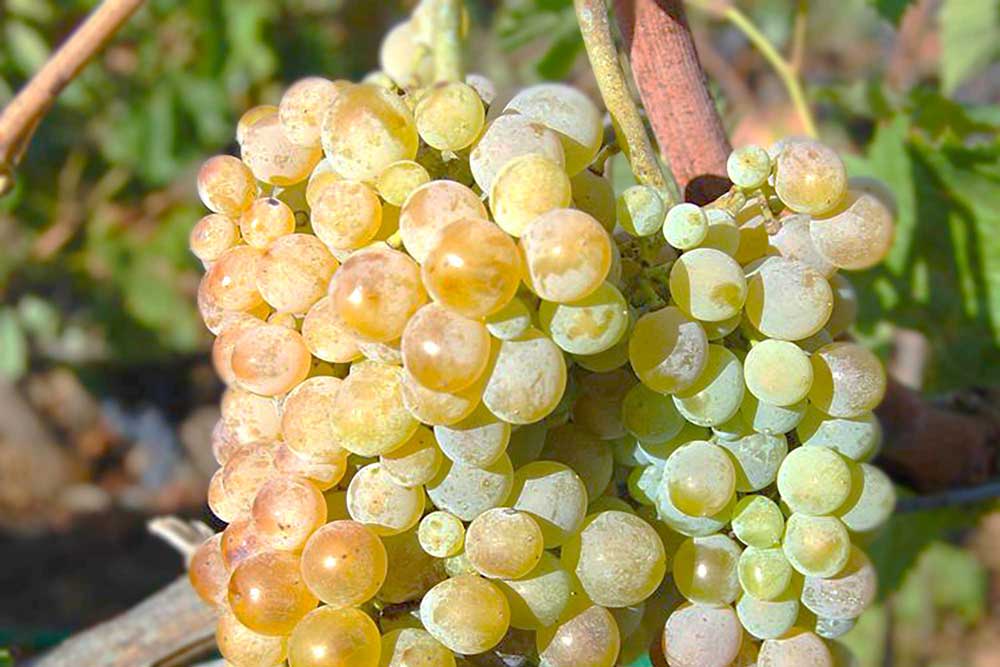
The variety has medium-sized, long and compact cylindrical bunches, typically winged on one side. The berries are medium-sized and spherical, with thick skins covered by a moderate bloom and displaying greyish tones with yellow highlights.
Falanghina is a fairly vigorous variety, with consistent, moderate yields. Harvest generally begins from the third week of September onwards.

The Grapes
Caprettone
Historically widespread throughout the province of Naples, particularly in the Vesuvius area, Caprettone is a white grape variety whose name probably derives from the distinctive shape of its bunch, which is said to resemble a goat’s beard. Despite its ancient origins, it has only recently been recognised as a distinct grape variety with its own genetic and productive profile.
It is an extremely vigorous variety, with fairly compact bunches and medium-sized berries, predominantly elliptical in shape, with thick skins.
Caprettone is generally harvested between the first and second ten days of September. At full ripeness, the grapes tend to have relatively low acidity.